
WHAT YOU NEED TO KNOW
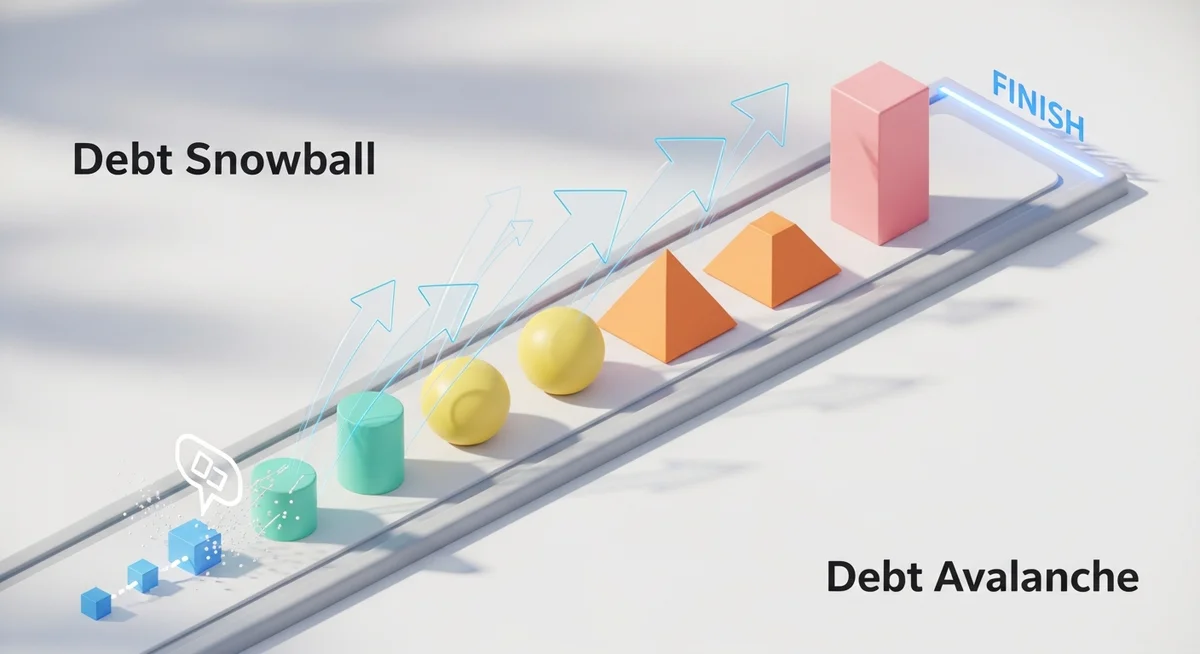
When comparing the Debt Snowball vs Debt Avalanche: Which Pays Off Faster depends on your priorities: the avalanche method mathematically wins, but the snowball method delivers faster psychological victories.
- The debt avalanche focuses extra payments on the account with the highest interest rate, minimizing total interest paid.
- The debt snowball focuses extra payments on the account with the smallest balance, generating fast psychological momentum.
- Both methods require you to maintain minimum payments on all other open accounts to protect your credit score.
- Choosing the right strategy depends on whether you value mathematical efficiency or emotional motivation more.
The key variable is your personal behavioral style, as the most effective strategy is simply the one you can consistently follow to completion.
What Is the Debt Snowball Method?
The debt snowball method is a debt reduction strategy where you pay off your bills in order of smallest balance to largest balance. It prioritizes quick emotional victories over interest rate optimization. By wiping out small balances rapidly, you build momentum, which helps you stay committed to your overall repayment plan.
If you are living paycheck to paycheck, this approach can quickly reduce the absolute number of monthly bills you have to manage. Personal finance resources at Payday Advisors emphasize that reducing the number of open accounts can simplify your monthly budgeting and relieve immediate financial anxiety.
How the Snowball Method Works
To implement this strategy, you must organize your accounts and allocate your funds systematically. Here is the step by step process for rolling your payments together:
- List your debts: Write down all your balances from the smallest dollar amount to the largest dollar amount, regardless of the interest rates.
- Pay the minimums: Maintain the required minimum payment on every single account on your list except the smallest one.
- Throw extra cash at the smallest: Put any extra money you can find in your budget toward paying off that smallest balance.
- Roll the payments over: Once the smallest debt is completely paid off, take its entire monthly payment and add it to the minimum payment of the next smallest debt.
Pros and Cons of the Debt Snowball
While this method is highly popular for its psychological benefits, it carries distinct drawbacks that can cost you money. You should weigh these factors before committing your extra cash to this plan:
- Pro: Fast motivation. Clearing an entire balance in the first few months provides a powerful sense of accomplishment.
- Pro: Simplified cash flow. Eliminating individual accounts reduces the total number of minimum monthly payments you have to track.
- Con: Higher overall cost. By ignoring interest rates, you may leave high interest debt untouched for longer, which increases your total interest paid.
- Con: Longer overall timeline. Because more of your money goes toward interest charges on neglected high rate accounts, it can take longer to become completely debt free.
What Is the Debt Avalanche Method?
The debt avalanche method is a strategy where you pay off your balances in order of the highest interest rate to the lowest interest rate. This approach is built on pure mathematical efficiency. By targeting high interest accounts first, you actively limit the amount of interest that accrues on your balances daily.
The Federal Trade Commission (FTC) recommends self-directed repayment plans like the avalanche method as a safe, low cost alternative to expensive debt relief services. It ensures that every extra dollar you pay works as hard as possible to reduce your principal balance.
How the Avalanche Method Works
Executing an avalanche plan requires strict adherence to interest rate rankings rather than balance sizes. Follow these steps to set up your payoff order:
- Rank by interest rate: List your debts from the highest annual percentage rate to the lowest annual percentage rate, ignoring the balance sizes.
- Pay minimums on the rest: Make the minimum monthly payments on all accounts except the one with the highest interest rate.
- Direct surplus funds to the top: Pay as much extra money as possible toward the account at the top of your list.
- Cascade the savings: Once the highest interest account is paid off, take the full amount you were paying toward it and redirect it to the account with the next highest interest rate.
Pros and Cons of the Debt Avalanche
The avalanche method is the mathematically superior choice, but it requires a high level of discipline to sustain. Consider the trade-offs of this structured approach:
- Pro: Maximum interest savings. You minimize the total amount of money paid to creditors over the life of your debt.
- Pro: Shorter path to zero. Less money spent on compounding interest means your principal balances decrease much faster.
- Con: Delayed gratification. If your highest interest debt has a very large balance, it may take many months or even years to fully eliminate your first account.
- Con: Higher risk of quitting. Without early visual victories, some borrowers lose motivation and abandon their repayment plans altogether.
Debt Snowball vs Debt Avalanche: Which Pays Off Faster?
When looking strictly at the timeline, the debt avalanche method pays off debt faster in almost all scenarios. By crushing the most expensive loans first, you prevent high interest rates from compounding against you. The mathematical reality is that saving money on interest directly translates to a shorter repayment period.
However, human behavior is not always driven by mathematics alone. If you struggle with consistency, the snowball method might actually get you to the finish line faster simply because it helps you stay the course without giving up.
Debt Snowball vs. Debt Avalanche Example
To see how these strategies compare in a real-world scenario, let us look at a household in 2026 managing three distinct debts. In this example, the household has an extra $300 per month to put toward their debt on top of the required minimum payments.
| Debt Name | Balance | Interest Rate (APR) | Minimum Payment |
|---|---|---|---|
| Credit Card A | $3,000 | 24% | $90 |
| Personal Loan B | $8,000 | 11% | $180 |
| Credit Card C | $1,500 | 18% | $45 |
Under the debt snowball method, you would prioritize Credit Card C first because it has the smallest balance of $1,500. Under the debt avalanche method, you would prioritize Credit Card A first because it has the highest interest rate of 24%.
Using the avalanche method for this specific 2026 scenario would save this household approximately $420 in total interest charges. It would also shave two months off the total repayment timeline compared to the snowball method, proving that targeting high rates is the faster mathematical path.
The Math (Avalanche) vs. The Psychology (Snowball)
According to research highlighted by the Consumer Financial Protection Bureau (CFPB), high interest credit card debt can quickly become unsustainable when households only make minimum payments. The avalanche method directly combats this risk by tackling the root cause of growing debt balances, which is the interest rate itself.
Even so, behavioral scientists often advocate for the snowball method because human beings need positive reinforcement. Eliminating an entire bill early in the process provides a psychological boost that reduces stress and builds a strong, long term financial habit.
How to Choose the Best Strategy for Your Goals
Deciding between these two strategies requires looking honestly at your personal habits and cash flow needs. Review this checklist to select the strategy that aligns best with your financial situation in 2026, and read our Privacy Policy to understand how we handle reader inquiries securely:
- Choose the debt avalanche if: You are highly disciplined, motivated by mathematical efficiency, and want to keep your total interest payments as low as possible.
- Choose the debt snowball if: You need immediate positive feedback to stay on track, have several small accounts that can be wiped out quickly, or need to free up monthly cash flow rapidly.
- Consider a hybrid approach if: You want to knock out one or two tiny, annoying balances first to build momentum, and then pivot the rest of your extra funds toward your highest interest accounts.